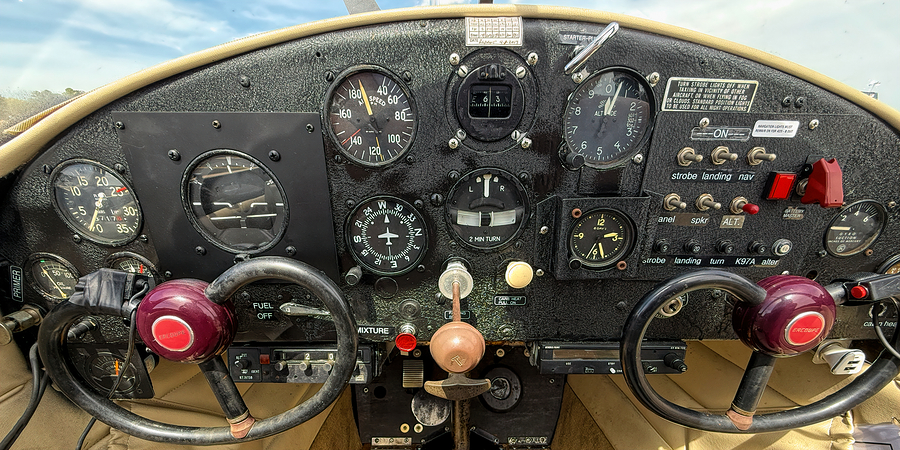
Try a Hawaii approach here.
An Often Underestimated Reality
A significant part of flying consists of understanding and then managing a dynamic system. A pilot does not deal with isolated parameters. They must connect speed, heading, wind, available time, remaining distance, drift, correction—essentially a continuously evolving spatial representation.
This is true in IFR, but also in VFR. Understanding a crosswind, anticipating a correction, maintaining a track, or chaining a trajectory requires more than theoretical knowledge. It requires understanding how parameters interact within a dynamic situation, and then being able to manage them.
The Difficulty in Training
This is precisely where a common difficulty lies. These skills are not built on a whiteboard. They require an environment where the dynamics actually exist, where multiple parameters evolve together, and where the student can observe, understand, and then act.
In practice, this work is carried out in conventional training environments, which are therefore costly—even though it focuses on intermediate skills that would benefit from being isolated, repeated, and trained earlier. The particularity of these skills is that they are cognitively demanding. Every instructor knows this situation: when certain fundamentals are not sufficiently consolidated, they create weaknesses that weigh on the session and come at the expense of the rest of the learning process.
The HOLD Response
By working on these specific skills upstream, HOLD reduces cognitive load and frees up mental capacity. HOLD addresses this need with a deliberately simple approach. The tool does not attempt to replicate the entire cockpit. It reproduces what is useful for working on trajectory and its dynamics: heading, speed, bank angle, time, distance, drift, correction, wind, and the sequencing of segments.
The idea is straightforward: make visible and trainable mechanisms that are currently practiced in more complex environments. The student can first understand what a change in speed produces, what a change in bank angle does, what a crosswind implies, or how available time affects the situation. Then they can learn to manage this dynamic: anticipate, correct, maintain a track, chain coherent actions, and preserve a stable mental representation of the trajectory.
The Benefit
The benefit of this approach is immediate. By working in advance on cognitively demanding skills, their impact is reduced when they must later be applied in training or in real operations.
In other words, HOLD does not simplify the problem. It simplifies the framework needed to work on it. This allows for better preparation, stronger consolidation, and greater availability during more comprehensive training phases.
In Practice
HOLD is not just a tool used as-is. It also allows users to build their own training programs.
Behind the interface, there are scenarios which, when grouped into modules, form training programs. An organization or instructor can define a briefing, choose initial parameters, display or remove certain aids, introduce instructions during the exercise, integrate timing elements, and set success criteria.
This makes it possible to build guided discovery, targeted training, or a complete progression tailored to a specific audience and pedagogical approach: BIA, PPL, IR…
In other words, HOLD does not just provide a dynamic environment. It also provides the means to build the pedagogy that goes with it. This allows each organization to retain its own training logic while relying on a shared, simple, and configurable tool.
Try HOLD — Take Control
The environment presented here is deliberately comprehensive and more IFR-oriented. It illustrates the richness of the tool. However, HOLD can also be deployed in a much simpler form, particularly for VFR use (fixed speed or altitude, removal of certain modes—as shown in the image at the top of the article), or for discovery phases, with a level of complexity tailored to the audience and training objectives.